%20(1)-B86R08ZzwhPzS6UZbG3mSxRWPCwGwn.png)



Most advice about how to improve domain authority starts with the wrong question: “How do I raise my score?” That question sends teams toward cheap links, inflated reports, and outreach campaigns that produce activity without creating ranking power. A higher Domain Authority or Domain Rating can be useful for comparison, but it isn't the asset you're trying to build.
The asset is a site that earns trust from relevant sources, covers its subject thoroughly, distributes authority to important pages, and keeps the equity it has already earned. I've seen enterprise teams spend months acquiring links while valuable pages remained isolated, outdated, or impossible to find through the internal link graph. The better approach treats authority as a systems outcome, not a backlink-volume target.
Table of Contents
- What Domain Authority Scores Do and Do Not Tell You
- Building Topical Authority Before Chasing Backlinks
- Executing Strategic Link Acquisition and Gap Analysis
- Recovering Lost Equity and Unlinked Mentions
- Technical SEO and Internal Linking Architecture
- Measuring Authority and Tracking Real Impact
What Domain Authority Scores Do and Do Not Tell You
A third-party authority score is a diagnostic signal, not a primary SEO KPI. Moz's Domain Authority and Ahrefs' Domain Rating are not Google ranking factors, and neither metric shows whether a commercial page attracts qualified visitors or converts them. A higher score can coexist with declining traffic, weak topic coverage, or links that have no useful relationship to the business.
The scores still have practical uses. I use them to compare domains within the same market, spot major changes in a link profile, and prioritize competitor research. I also compare the output from a domain authority checker with rankings, organic traffic, referring-domain quality, and page-level performance. The question is whether credible relationships are supporting pages that matter, not whether a dashboard has produced a better number.
What authority metrics represent
The historical evidence points to link quality, referring-domain diversity, and structural centrality, rather than raw backlink totals. Ahrefs analyzed 11.8 million Google search results. Its findings, summarized in this analysis of backlinks as a ranking factor, associated overall link authority with higher rankings, identified referring-domain count as a leading indicator of overall domain traffic, and reported that a 10-point increase in Domain Rating corresponded to about 27% more organic traffic. The same summary reported that sites with DR 50+ ranked about 2.7 times faster for new content than sites below DR 30.
Those figures support a useful direction, not a target threshold. A site should earn links from multiple reputable domains relevant to its market. A web-scale benchmark that used PageRank across 10,000 domains treated link-based centrality as the primary proxy for domain prestige. Its methodology is described in the web-scale authority benchmark. The implication is straightforward: links from structurally important sites carry more weight than a large collection of weak references.
Practical rule: If a link will not help a relevant reader discover, trust, or use your content, do not buy it because a tool assigns the linking domain a high score.
Why the score gets harder to move
DR is logarithmic on a 0 to 100 scale, so progress becomes harder as a domain moves higher. A small change near the top is a different event from the same numerical change on a newer or weaker site. Treating every point as equal encourages poor decisions, especially when teams attach bonuses or campaign targets to an arbitrary score.
Use a portfolio view instead. Track the quality and relevance of new referring domains, the pages receiving links, the rankings of those pages, and the organic traffic they generate. Review whether new mentions strengthen a topic cluster or improve authority flow through the internal link graph. A third-party score may follow those improvements. If it rises without them, investigate the dataset and the link profile before reporting success.
Building Topical Authority Before Chasing Backlinks
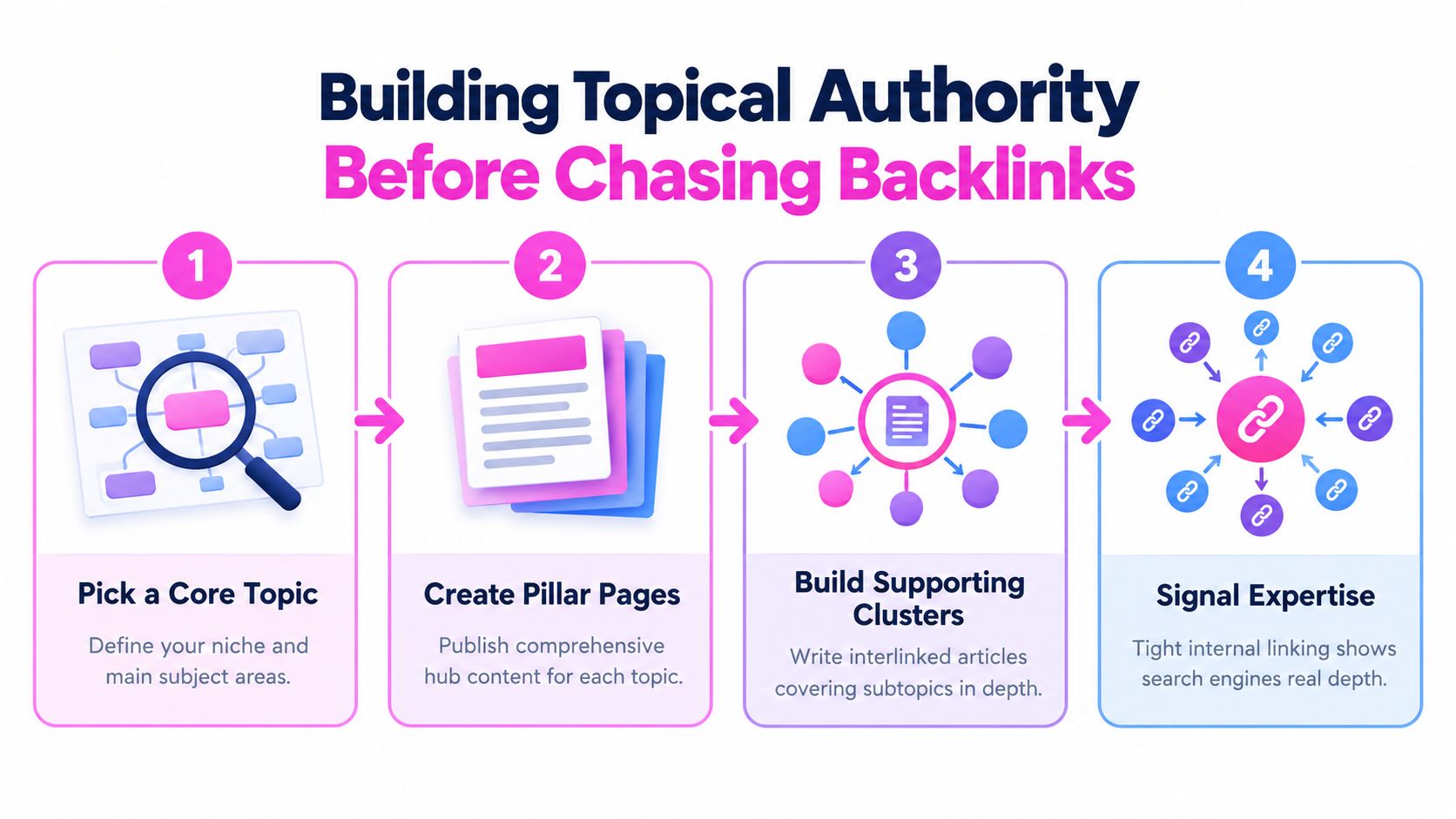
You can't compensate for a shallow site with a pile of unrelated links. Before I approve an outreach campaign, I check whether the target domain has a coherent set of pages that deserve to rank and can support one another. A relevant link to a complete topic cluster has somewhere useful to land. A link to a thin page often produces a short-lived signal with little value for users or the rest of the site.
I start with keyword clustering, competitor page analysis, and cannibalization checks. SemDash can be one option for this workflow, alongside other keyword and SERP platforms. The point isn't which interface I use. The point is mapping queries to distinct pages based on search intent, not publishing one article for every minor variation.
Start with the topic map
I build the map from the business's core products, customer problems, and existing organic competitors. Then I group related queries into themes and inspect the current SERPs for each group. If the same page ranks for several related queries, those terms may belong together. If search results consistently separate the intents, I create separate page assignments.
The audit usually reveals one of three problems:
- Fragmented coverage: Several weak articles address pieces of a subject, but none provides a dependable overview.
- Cannibalization: Multiple URLs compete for the same intent, splitting internal links and confusing page selection.
- Missing support pages: A commercial or pillar page exists, but it lacks the explanatory content that answers related questions.
I assign one primary intent to each URL. A pillar page handles the broad subject and links to focused subpages. Each subpage answers a narrower question and links back to the pillar when that connection helps the reader. Related subpages can link to one another, but I don't force links merely to increase their count.
Build depth that earns citations
A useful cluster needs original substance. That might mean first-hand implementation details, a clear methodology, original analysis, expert commentary, or a practical tool. A generic rewrite of the current top results doesn't create a strong reason for another publisher to cite the page.
I also make the page easy to reference. Put the direct answer near the beginning, use descriptive subheadings, define terms before using them, and support claims with primary sources. Journalists and practitioners link to pages that reduce their research burden. They don't link because a page contains a target keyword a certain number of times.
One relevant, high-authority link can be more valuable than hundreds of generic links when it points into a cluster that demonstrates real topical coverage. That doesn't mean one link always beats hundreds in every ranking situation. It means context and destination determine whether authority compounds.
Consolidate before promoting
I won't promote five overlapping pages when one stronger page could serve the intent better. I compare rankings, organic entrances, backlinks, and conversion paths, then choose whether to merge, redirect, rewrite, or keep the URLs separate. Consolidation can reduce index clutter and concentrate internal and external signals, but I don't redirect pages blindly. A page with distinct intent, useful traffic, or valuable links may need preservation and clearer positioning instead.
The most common failure is publishing more content before fixing the map. More URLs don't automatically create more authority. A clean cluster gives every future link a stronger destination and makes internal linking decisions much easier.
Executing Strategic Link Acquisition and Gap Analysis
Once the content foundation is credible, I use competitor backlink gaps to identify prospects. I don't export every competitor link and hand it to an outreach team. That creates a large list of publishers with very different editorial standards, audiences, and reasons for linking.
I first compare several direct competitors, then classify the linking domains by page type and editorial purpose. A domain that links to a competitor's original research may be a strong prospect for my own data-led asset. A domain that links only to a discontinued promotion may be irrelevant. The gap is a starting point, not a prospecting verdict.
Score the opportunity, not the domain
I evaluate each target against four questions:
- Topical fit: Does the publisher regularly cover the subject, audience, or problem addressed by my page?
- Editorial context: Would the link sit naturally inside a useful article, resource page, study, or reference section?
- Destination quality: Does my page add something the existing article lacks, or am I asking the editor to replace a perfectly adequate reference?
- Audience value: Could a reader plausibly click the link and find it useful?
I then prioritize domains that are relevant, trusted, and structurally central within the niche. A web graph built from diverse verticals, including news, government, education, and commercial sites, reinforces why diversity and centrality matter. I'm looking for credible nodes in the market's information network, not just sites that advertise link placements.
Moz's backlink guidance also distinguishes links from varied referring domains and explains that the authority and quality of the linking website affect the value passed to a destination. That guidance is available in Moz's explanation of backlink quality and authority.
Use placement evidence
Placement quality deserves its own column in the campaign sheet. I record the proposed URL, surrounding topic, anchor language, link attribute where visible, estimated referral value, and the reason the editor might include the reference. I also record whether the page is indexed and whether the publisher has a history of maintaining useful content.
A large analysis of 350,159 backlink placements across 13,002 landing pages reported 14% organic traffic growth, 150% keyword-rank improvement, 275% more impressions, and a 3.5-position average ranking gain after links were placed. The same analysis found Domain Power more predictive of improvement than Moz DA or Ahrefs DR. Those figures come from the backlink-placement analysis by Search Atlas. I treat the results as directional evidence, not a promise for every campaign, because placement quality and page context vary.
Write outreach around the missing value
My outreach doesn't lead with “Can you add my backlink?” It identifies a specific gap in the publisher's existing page and explains how my resource resolves it. For example, I might point out that an article describes a process but lacks a current checklist, or that a definition would benefit from a worked example.
The pitch should be short enough to scan and specific enough to prove I've read the page. I include the exact suggested destination, explain the reader benefit, and offer to correct or supplement the resource if the page isn't a fit. I don't demand a particular anchor text or imply that a paid placement is editorial.
When several people manage outreach, I also verify contact ownership before sending. A resource on safe email verification for sales teams can help teams reduce misdirected pitches and protect relationships with legitimate publishers.
The best outreach request is easy to reject for the wrong reason and easy to accept for the right one. Give the editor a clear editorial justification, not a ranking lecture.
Guest posting can support visibility and referral traffic when the publication is relevant, but I don't use it as a factory for exact-match anchors. Paid, irrelevant, or network-based links may inflate a report while exposing the domain to quality and compliance risks. I'd rather earn fewer links that make sense in the surrounding content than fill a dashboard with placements no user would trust.
Recovering Lost Equity and Unlinked Mentions
The first link-building project I inspect on a mature site is often recovery, not acquisition. Website migrations, product renames, deleted resources, and careless redirects leave valuable references pointing at errors or obsolete URLs. Recovering that equity can be less disruptive than persuading a new publisher to mention the brand for the first time.
I use a repeatable audit rather than relying on a single crawler export.
Find the leaks
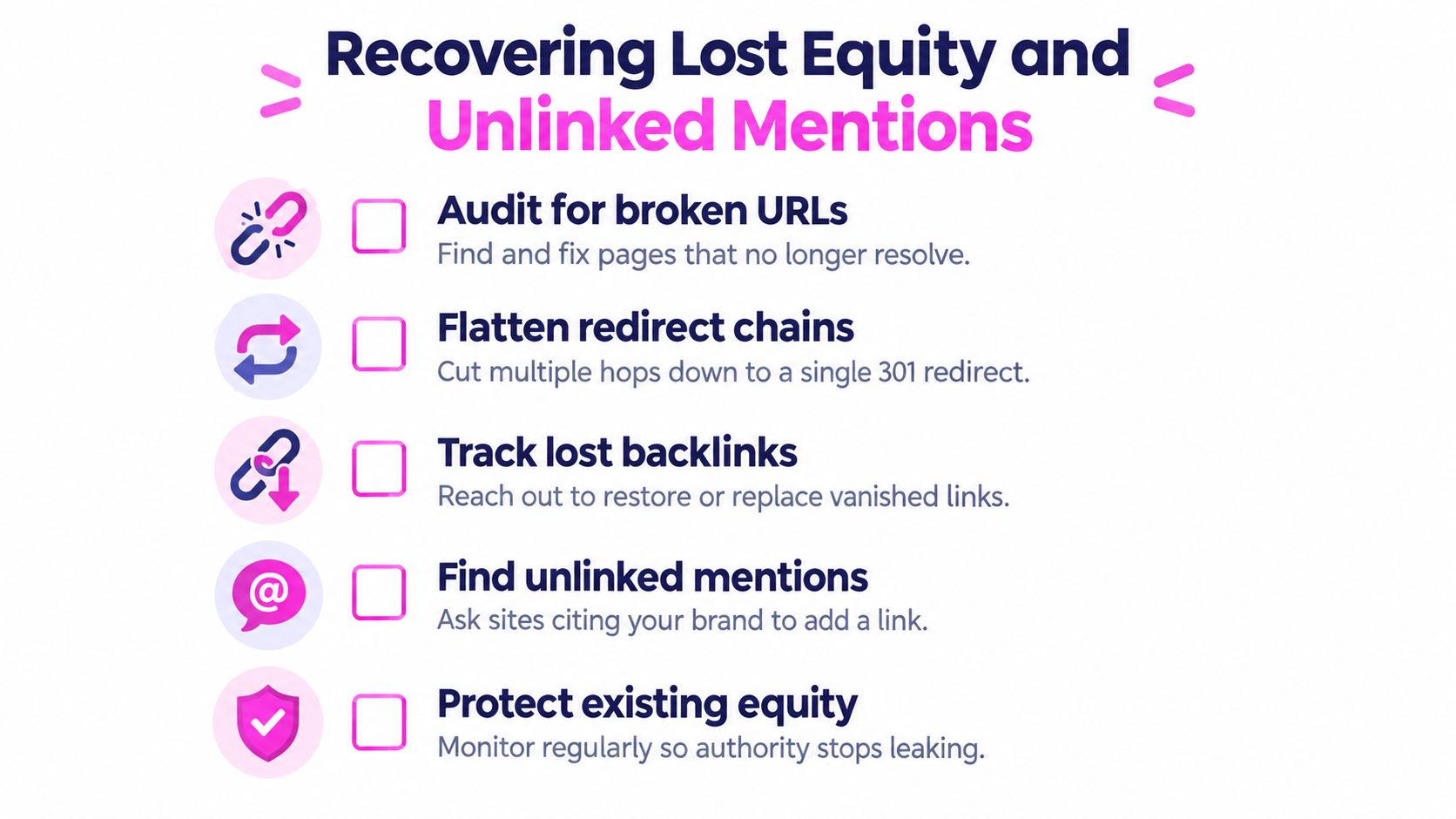
I begin by comparing historical backlink data with the current URL inventory. I filter for linked pages returning a 404, redirecting through multiple hops, or resolving to an irrelevant destination. Then I review the linking page manually. A link from a relevant article may justify a precise redirect or a restored page, while a low-quality automated reference may not deserve any intervention.
The decision tree is simple:
- The original content still belongs: Restore the page at the original URL.
- A close successor exists: Redirect the old URL directly to the most relevant replacement.
- The topic has been retired: Contact the linking publisher with a useful alternative, or leave the URL gone if no honest replacement exists.
- The link is manipulative or irrelevant: Don't preserve it merely to increase a metric.
I avoid chains of redirects because every extra hop adds maintenance risk and can send users and crawlers through unnecessary destinations. I also check internal links after each migration, since a redirect outside the site won't repair links that still point to an obsolete path.
Reclaim mentions with a reason
Unlinked mentions are strongest when the publisher has already recognized the brand, study, product, or expert. I monitor brand names, product names, distinctive research titles, and executive names across publications, podcasts, directories, and relevant communities. A mention in a podcast description or directory may not behave exactly like an editorial backlink, but it can reveal a relationship worth developing.
The workflow for reclaiming unlinked brand mentions should end with a human review, not an automated request to every site that names the company. I check whether the mention is accurate, whether a link would help readers, and whether the publisher controls the page.
My email usually references the exact sentence, supplies the preferred destination, and explains what the reader gains. I don't frame the request as a correction unless the page contains an actual error. That small distinction improves the tone and protects the relationship.
I schedule this audit after migrations, major information-architecture changes, and content pruning. I also keep a recovery queue so developers can fix URL problems while outreach specialists handle publishers. Authority preservation isn't glamorous, but it often produces cleaner results than starting another cold campaign.
Technical SEO and Internal Linking Architecture
External links provide potential authority to individual pages. Internal links decide where much of that potential can travel. If a site earns strong links to a research article but never connects that article to the service pages it supports, the commercial section may remain weak even though the domain has valuable equity.
I start by identifying pages that attract the strongest external links, then map their internal connections. The objective isn't to force every powerful URL to link to a money page. It's to create useful paths from trusted informational assets to relevant category, product, or service pages.
Build a deliberate link graph
Semrush recommends using strong pages to link to pages that need ranking support and connecting pillar pages with their subpages. Its guidance on internal links and authority distribution reflects a workflow I use in audits:
- Pillar to subpage: The broad guide introduces and links to deeper explanations.
- Subpage to pillar: The detailed article gives readers a route back to the broader framework.
- Subpage to subpage: Related topics connect when the relationship is clear and useful.
- Authority page to target page: A page with strong external links supports a relevant priority URL.
- Navigation to important content: Key pages aren't hidden several clicks deep or left without internal references.
I choose anchors that describe the destination naturally. Repeating an exact commercial phrase across every internal link makes the architecture look engineered and often produces awkward copy. The link should help a reader predict what happens after the click.
Fix crawl and rendering barriers
A technically healthy site lets crawlers discover, render, and index the pages I've worked to strengthen. I check robots directives, XML sitemaps, canonical signals, status codes, rendering dependencies, and indexation patterns. A page blocked from crawling or loaded only after unreliable client-side scripts can't benefit fully from the content and links surrounding it.
Broken internal links deserve priority because they interrupt user journeys and authority flow. Orphan pages create a related problem. A page may be excellent and externally linked, yet receive little internal support because no relevant URL points to it. I locate orphans by comparing the URL inventory with the internal link graph, then add links from contextually appropriate pages.
Connect architecture to business priorities
A common mistake is linking only to the homepage because it has the strongest brand recognition. I prefer a tiered structure. The homepage supports major categories, category pages support products or services, and informational content supports the questions that move prospects toward those pages.
I also review internal links after consolidation. A redirect may preserve a destination for external users while dozens of internal references still point to the old URL. Updating those links reduces unnecessary hops and clarifies which page owns the topic.
Technical details outside SEO can matter to operational trust as well. For teams managing outreach infrastructure, a resource that helps them check SPF and DKIM records can support reliable email delivery, although it doesn't replace the editorial and technical work required on the website itself.
Measuring Authority and Tracking Real Impact
I report authority work through a chain of evidence, not a single score. The chain starts with the referring domain and placement, moves through the linked page and its cluster, and ends with rankings, organic visits, qualified actions, and revenue where tracking allows.
A rising authority metric can be encouraging, but it doesn't prove that the campaign worked. I want to know whether the links were placed in relevant contexts, whether the receiving pages improved, and whether the pages now support a broader set of valuable queries.
Build a page-level measurement set
For every meaningful placement, I record the linked URL, the referring domain, the page context, the target cluster, and the date the link became visible. I compare pre-link and post-link performance for the receiving page, while separating the effect of content updates, seasonality, technical releases, and algorithm changes.
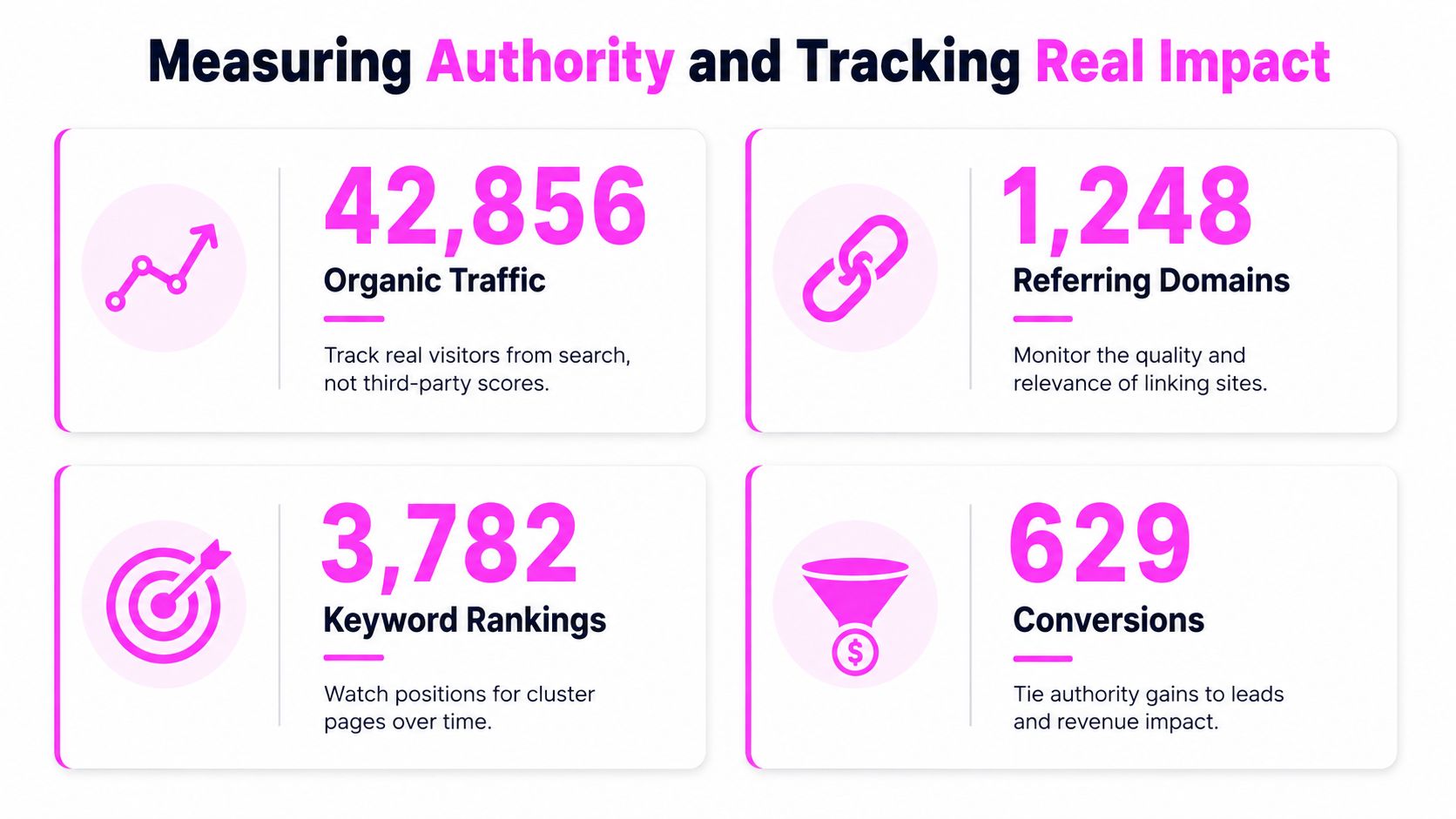
The measures I trust most are:
- Referring-domain quality: Is the site relevant, credible, and editorially maintained?
- Placement context: Does the link appear where a reader would expect supporting evidence?
- Keyword movement: Do the target page and related cluster pages improve for relevant queries?
- Organic traffic: Are more appropriate searchers reaching the site?
- Conversions: Do those visitors complete meaningful actions?
- Link retention: Does the publisher keep the reference live and accessible?
The placement study cited earlier found measurable lift across organic traffic, impressions, keyword rankings, and average position, but I still segment results by page type and placement quality. A link to a mature informational asset won't behave like a link to a new commercial page. Reporting the blended average can hide that difference.
Use scores for diagnosis
I keep Domain Authority and Domain Rating in the dashboard for competitive context and trend monitoring. I don't attach campaign success to a fixed score because logarithmic metrics become harder to move and different tools use different datasets. A score is useful when it prompts a question, such as why a competitor has broader referring-domain coverage or why a recent migration caused a sudden decline.
Measurement standard: A link-building campaign earns its budget when it improves the visibility and usefulness of important pages, not when it produces the largest export.
I review the dashboard at the domain and URL levels. Domain-level data shows whether the referring-domain portfolio is becoming healthier and more diverse. URL-level data shows whether authority reaches the pages that generate leads, sales, subscriptions, or other business outcomes.
SemDash brings keyword discovery, clustering, competitor gap analysis, backlink research, SERP history, and unlinked-mention and broken-backlink recovery into one SEO workspace. Use SemDash to map topic coverage, prioritize relevant referring domains, and measure whether recovered or newly earned links are supporting the pages that matter.